


| Quantity: | |
|---|---|


For mining enterprises, port terminals, and long-distance bulk material handling operations, selecting a high-strength, standard-compliant conveyor solution capable of withstanding extreme loads and demanding environments is essential. Our steel cord conveyor belt is engineered to meet international performance standards, delivering superior tensile strength and stable conveying performance for heavy-duty, long-span applications. Built with a precision-engineered structure, it features high-tensile galvanized steel cords arranged longitudinally within a rubber matrix, providing exceptional strength, low elongation, and excellent impact resistance. The belt is constructed with premium-grade rubber covers that offer outstanding resistance to abrasion, wear, corrosion, and environmental factors, ensuring long service life even in harsh operating conditions. With a wide operating temperature range typically from -20℃ to +80℃ (customizable for higher or lower extremes), it is suitable for transporting high-density materials such as coal, ore, and aggregates over long distances and at high speeds. Unlike conventional fabric conveyor belts, this model is optimized for maximum load capacity, minimal stretch, and enhanced operational efficiency, reducing downtime and maintenance costs, making it the ideal choice for high-capacity, continuous conveying systems.
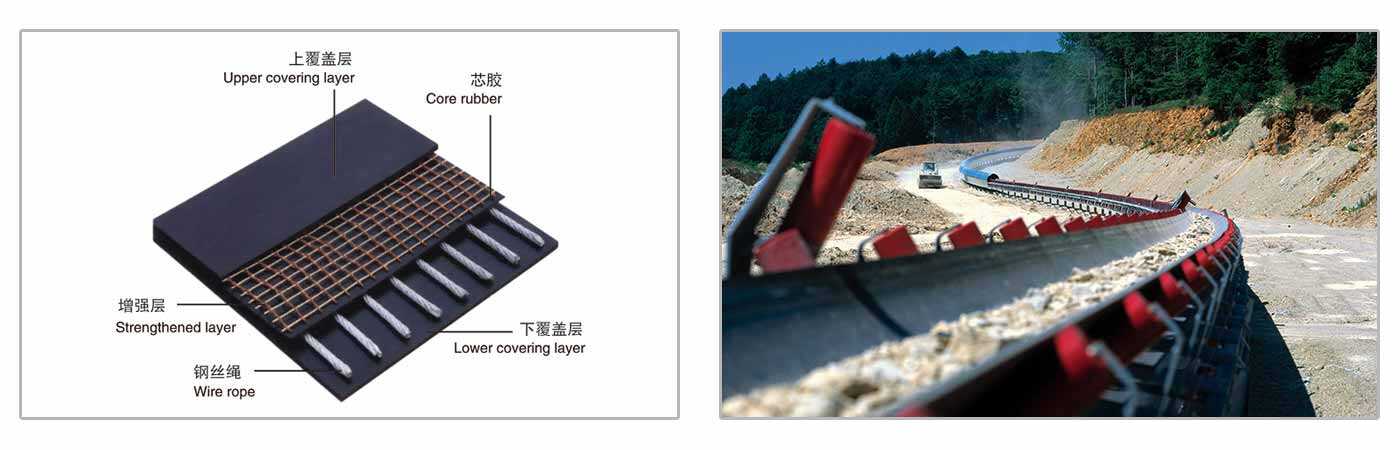
Features and Benefits
Available belt strength ranges from 630N/mm up to 7,500N/mm covering a variety of applications.
Available Cover Compounds
JINFLEX Conveyor Belt offers a wide range of abrasion, impact, cut & gouge, temperature, flame, and other speciallized grades.
Realize minimum take up distance, best suited for long distance or other specialized conveyors with short transitions, small pulleys and yet high throughput rates.
Multiple types available for customization
This product provides Normal、Fire Resistant、Conventional Fire Resistant、Heat Resistant、Abrasion Resistant、Heat&Abrasion Resistant、Acid,Alkali&Oil Resistant、Cold Resistant、Ozone Resistant Various types are available, and unique customization can be made according to your requirements
Unparalleled performance
The highest quality materials, design, manufacturing, and quality control create trouble free high-quality belts.
cost-effective
Support on-demand customization to meet your long-term stable transportation needs at a more economical procurement cost.
On-time delivery rate
Short cycle delivery+adaptation to international logistics rhythm, helping you shorten project landing time
Why Choose us
No MOQ & Support for Small Batches
Benefit from our 20-million-meter annual production capacity. We efficiently handle small orders with on-time delivery, perfect for pilot runs or specialized projects.
Full Customization Capabilities
We support fully independent customization—from compound formulas to belt specifications—to develop the ideal solution for your unique conveying needs.
Proven Cost-Effectiveness & Reliable Quality
Backed by 50+ years of expertise, ISO/CE/MA certifications, and optimized processes, we deliver reliable performance (low elongation, high adhesion) at an economical price point.
Reference Specification
Technical Data for Steel Cord Conveyor Belt According to DIN22131
| Technical Data\Specification | ST1000 | ST1250 | ST1600 | ST2000 | ST2500 | ST3150 | ST3500 | ST4000 | ST4500 | ST5000 | ST5400 | |
| Tensile Strength (N/mm) | 1000 | 1250 | 1600 | 2000 | 2500 | 3150 | 3500 | 4000 | 4500 | 5000 | 5400 | |
| Max Diameter of Cord (mm) | 4.1 | 4.9 | 5.6 | 5.6 | 7.2 | 8.1 | 8.6 | 8.9 | 9.7 | 10.9 | 11.3 | |
| Pitch of Cord (mm) Tolerance:+1.5 | 12 | 14 | 15 | 12 | 15 | 15 | 15 | 15 | 16 | 17 | 17 | |
| Top Rubber Cover Thickness (mm) | 4 | 4 | 4 | 4 | 5 | 5.5 | 6.5 | 7 | 7.5 | 8 | 9 | |
| Bottom Rubber Cover Thickness (mm) | 4 | 4 | 4 | 4 | 5 | 5.5 | 6.5 | 7 | 7.5 | 8 | 9 | |
| Width (mm) | Cord Number | |||||||||||
| Width (mm) | Tolerance (mm) | |||||||||||
| 500 | ±5 | 39 | 34 | - | - | - | - | - | - | - | - | - |
| 650 | ±7 | 51 | 44 | - | - | - | - | - | - | - | - | - |
| 800 | ±8 | 64 | 55 | 50 | 64 | - | - | - | - | - | - | - |
| 1000 | ±10 | 81 | 69 | 64 | 81 | 64 | 64 | 64 | 64 | 59 | 55 | 55 |
| 1200 | ±10 | 97 | 84 | 77 | 97 | 77 | 77 | 77 | 77 | 71 | 66 | 66 |
| 1400 | ±12 | 114 | 98 | 90 | 114 | 90 | 90 | 90 | 90 | 84 | 78 | 78 |
| 1600 | ±12 | 131 | 112 | 104 | 131 | 104 | 104 | 104 | 104 | 96 | 90 | 90 |
| 1800 | ±14 | 147 | 127 | 117 | 147 | 117 | 117 | 117 | 117 | 109 | 102 | 102 |
| 2000 | ±14 | 164 | 141 | 130 | 164 | 130 | 130 | 130 | 130 | 121 | 113 | 113 |
| 2200 | ±15 | 181 | 155 | 144 | 181 | 144 | 144 | 144 | 144 | 134 | 125 | 125 |
| 2400 | ±15 | 197 | 169 | 157 | 197 | 157 | 157 | 157 | 157 | 146 | 137 | 137 |
Standard and Main Technical Data
| Type | Standard and Main Technical Data | ||||||||
| Normal/Conventional | GB/T9770,DIN22131,JS6369,AS1333 | ||||||||
| Fire Resistant | MT668,HG2539,DIN22131 | ||||||||
| ConventionalFire Resistant | HG253911,DIN22103,DIN22131 | ||||||||
| Heat Resistant | HG/T2297,1S04195 | ||||||||
| Abrasion Resistant | Shore Abrasions≤90mm:DIN22131-W Shore Abrasions≤70mm*AS1333-A | ||||||||
| Heat & Abrasion Resistant | Heat Resistance≤125℃,Shore Abrasions≤150mm3 | ||||||||
| Acid, Alkali & Oil Resistant | HG4-846,HG/T3714,RMA( MOR, OR ) | ||||||||
| Cold Resistant | Fragility Temperature -50℃~-20°C,HG/T3647 | ||||||||
| Ozone Resistant | (Ozone Density)50PPHM 40°C/72h( No Crack) |


