

Views: 0 Author: Site Editor Publish Time: 2026-09-29 Origin: Site


Selecting the correct 4-wire spiral hose presents a common engineering challenge today. On paper, 4SP and 4SH variants appear nearly identical to many buyers. Misidentifying the necessary hose leads to serious operational issues immediately. Under-speccing causes catastrophic failures, massive fluid leaks, and severe safety hazards. Conversely, over-speccing creates unnecessary routing difficulties and inflates your material costs. We know both types handle severe applications exceptionally well. However, their distinct pressure tolerances and physical flexibility dictate entirely different equipment use cases. In this article, you will learn the exact structural differences between these two hoses. We will break down their performance metrics and flexibility trade-offs clearly. You will discover practical frameworks to match the right hose to your specific machinery. We will also cover crucial installation risks, fitting compatibility, and sensible cost analysis to guide your final procurement decision.
4SP hydraulic hose is optimized for medium-to-high pressure applications where tighter bend radii and routing flexibility are critical.
4SH hydraulic hose handles extreme, sustained high pressures and heavy pressure spikes, utilizing thicker steel wire at the cost of flexibility.
Both hoses fall under the DIN EN856 hose standard but require specific, non-interchangeable fitting solutions (often interlocking for 4SH).
Choosing the "stronger" hose (4SH) is a mistake if your equipment's physical constraints cannot accommodate its stiff bend radius.
Before comparing performance, we must understand how manufacturers construct these hoses. Both 4SP and 4SH feature a specialized four-wire architecture. They do not use the braided steel wire found in standard 1SN or 2SN hoses. Braided wires crisscross over each other. When pressure spikes occur, braided wires rub together and create friction. This internal friction eventually weakens the hose core over time.
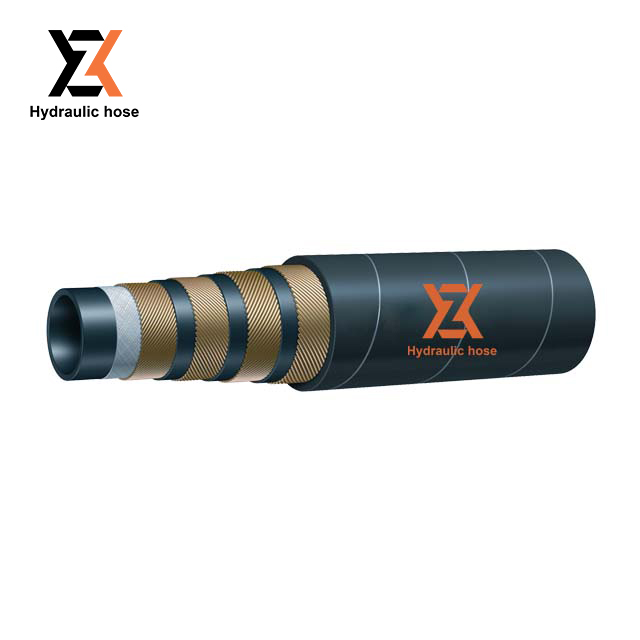
Instead, a spiral high pressure hose uses parallel steel wires. Manufacturers wrap these wires tightly around the inner rubber tube. They apply alternating layers in opposing directions. This parallel wrapping eliminates wire friction. It allows the hose to absorb massive pressure shocks repeatedly. It withstands high impulse cycles far better than any braided alternative.
Both models adhere strictly to the European DIN EN856 standard. This benchmark dictates rigorous safety margins, dimensional tolerances, and testing protocols. When you specify a DIN EN856 hose, you guarantee a baseline of industrial-grade reliability. The standard defines SP as "Special Pressure" and SH as "Super High Pressure." They share the same regulatory framework but target different extremes.
Structurally, they look similar but differ in crucial physical dimensions. The 4SH variant utilizes thicker, heavier gauge steel wire. It requires a slightly thicker inner synthetic rubber tube to support this heavy wire armor. Consequently, the 4SH features a larger overall outside diameter (OD) than a 4SP of the same internal diameter. The 4SP uses a slimmer wire profile. It maintains a thinner OD, which directly influences how you install and route it through compact machinery spaces.
The primary divider between these two options is their maximum working pressure. In any identical internal diameter size, 4SH consistently outperforms 4SP. The heavier gauge wire wrap absorbs significantly more radial force. For example, in a 1-inch size, a 4SP hose typically rates around 280 bar (4,060 psi). In contrast, the 4SH equivalent comfortably handles 380 bar (5,510 psi).
This pressure gap becomes critical during dynamic equipment operation. Hydraulic systems rarely operate at static pressures. Actuating cylinders and moving heavy loads create violent dynamic pressure spikes. We call these impulse shocks. The 4SH excels in impulse fatigue resistance. It absorbs rapid spikes without stretching or degrading the inner core. If your machinery generates aggressive, sudden pressure surges, you need the SH designation.
Pressure capability always comes with a physical cost. You trade flexibility for strength. Because 4SH uses thicker spiral wire and features a larger OD, it resists bending. It behaves rigidly. The minimum bend radius dictates how tightly you can loop the hose before it compromises the core.
This is where 4SP shines. Its slimmer profile allows for a significantly tighter bend radius. It bends easily around sharp corners and complex machine frames. If you force a 4SH hose into a tight bend radius, the steel wires will distort. The outer cover may tear, and the hose will fail prematurely. 4SP represents the superior choice for compact machinery. It allows routing through tight bulkheads without damaging the structural integrity of the line.
You must also account for physical weight. The heavier wire gauge makes 4SH noticeably heavier per meter. On short stationary runs, weight rarely matters. However, consider long boom runs on mobile excavators or agricultural lifts. Adding heavy lines across a telescoping boom increases mechanical drag. It strains mounting brackets and bulkheads.
Furthermore, the larger OD of 4SH makes it more susceptible to external abrasion. It rubs against neighboring components in tight channels. The slimmer 4SP tucks neatly away from moving parts, reducing its vulnerability to friction wear in crowded engine bays.
| Specification Feature | 4SP Hydraulic Hose | 4SH Hydraulic Hose |
|---|---|---|
| Primary Application | Medium-to-high pressure, compact spaces | Extreme high pressure, heavy impulse loads |
| Wire Gauge Thickness | Standard spiral wire | Heavy-duty spiral wire |
| Overall Flexibility | High (Tighter bend radius) | Low (Stiff, requires wide routing) |
| Weight Profile | Moderate weight | Heavy weight |
| Impulse Resistance | Excellent | Superior / Maximum capability |
Selecting the right specification requires you to evaluate your machinery realistically. Pressure requirements dictate your baseline. Bend radius dictates your physical reality. Here is how you determine the correct fit.
You should default to a 4SP hydraulic hose when routing flexibility outweighs extreme pressure needs. We see it used frequently in environments that demand intricate plumbing. Consider standard construction equipment, agricultural tractors, and municipal service vehicles. These machines utilize densely packed hydraulic manifolds.
Compact spaces: It navigates tight engine compartments seamlessly.
Moving linkages: It flexes easily with articulated steering joints.
Installation outcome: You achieve lower installation difficulty. You reduce stress on threaded connection points because the hose does not constantly fight the fitting.
You must specify 4SH when operating forces exceed standard limits. Heavy-duty earthmoving equipment, deep mining excavators, and industrial hydrostatic drives require this level of protection. These systems experience violent, continuous pressure shocks. A standard hose would rupture under these conditions.
Extreme environments: It survives continuous shock loads in rock crushers and drill rigs.
Hydrostatic drives: It manages the massive torque and pressure required to propel heavy tracks.
Installation outcome: You gain maximum safety and long-term longevity under the most severe mechanical stress possible.
Many engineers fall for the "bigger is better" fallacy. They assume installing a higher-rated hose guarantees better performance. Installing a heavier 4SH line where 4SP suffices creates severe problems. The stiff nature of the SH line makes it incredibly difficult for mechanics to install. It fights the wrench. It places immense lateral stress on the hydraulic pump fittings. Over time, this stress cracks cast iron manifolds. It causes kinked lines and dramatically increases labor time during routine maintenance.
You must pay strict attention to fitting compatibility. Fittings are not universally interchangeable between these two hoses. Even if they share the exact same internal diameter, their outside diameters differ greatly. Their wire structures demand different crimp dimensions.
You cannot use a standard crimp fitting on a super high-pressure line. Due to the extreme forces involved, a 4SH hydraulic hose typically requires specialized interlocking fittings. These interlocking designs bite directly into the wire reinforcement. They lock the inner tube and outer cover simultaneously. Using incorrect fittings results in dangerous blow-offs under maximum load, endangering operators and equipment.
To achieve this mechanical lock, you must prepare the hose ends properly before crimping. This process is called skiving.
External Skiving: Both models generally require removing the outer rubber cover down to the steel wire. This allows the metal teeth of the fitting to grip the steel reinforcement directly.
Internal Skiving: For extreme 4SH applications, you may also need internal skiving. This involves removing a small portion of the inner rubber tube. The fitting then clamps the steel wire from both the inside and the outside, creating an unbreakable mechanical bond.
Skipping the skiving process on these thick spiral lines guarantees a catastrophic fitting failure. Always follow the manufacturer's precise crimp specifications.
Improper installation destroys spiral hoses faster than high pressure. You must follow strict routing practices to protect your investment.
Avoid torsional twist: Never twist the hose during installation. A minor 5-degree twist can reduce spiral hose service life by up to 70%. Use two wrenches to tighten fittings.
Respect the bend radius: Never bend the line tightly immediately behind the crimp shell. Allow a straight run of at least two times the hose OD before starting a bend.
Use proper clamping: Secure heavy 4SH lines with proper hydraulic clamps to prevent them from vibrating and abrading against the chassis.
Procurement teams naturally notice the base per-meter cost difference. 4SH requires heavier steel wire and thicker rubber compounds. Therefore, it costs significantly more to manufacture. Upfront material costs will always be higher. However, you should never base your purchase solely on the initial price per meter.
You must frame the cost as insurance against unscheduled downtime. Utilizing a cheaper 4SP line in an application that actually demands 4SH will lead to premature blowouts. The material savings vanish instantly when a machine fails. A ruptured line costs infinitely more in halted operations, emergency mechanic labor, and hazardous fluid loss. Replacing gallons of high-grade hydraulic oil often exceeds the cost of the hose itself. Always specify the hose that matches your operational extremes.
Managing a massive fleet requires strategic inventory control. Stocking dozens of different hose types complicates your supply chain. If your machinery parameters allow it, standardizing on one type across a fleet reduces inventory complexity.
For instance, if your entire fleet consists of heavy earthmovers, standardizing on the heavier specification ensures you always have the right bulk reel on hand. However, if your fleet relies heavily on compact loaders and agile equipment, standardizing on the more flexible SP variant speeds up maintenance times. Evaluate your fleet's dominant needs and align your bulk purchasing accordingly.
Choosing between these two robust fluid power solutions requires careful consideration of both pressure demands and spatial limitations. Pressure dictates your minimum requirement, but the physical bend radius dictates your practical application.
Here are your core takeaways for final selection:
Always assess the maximum impulse pressure of your specific hydraulic system before ordering.
Use 4SP for flexible, high-pressure routing in compact machinery spaces.
Use 4SH for inflexible, extreme-pressure environments like heavy excavators and hydrostatic drives.
Never install a rigid, heavy-duty hose in a tight bend radius; it will kink and fail.
Ensure your technicians use the exact matching fittings and skiving tools required for spiral reinforcements.
Do not guess when it comes to high-pressure safety. We strongly encourage you to consult your equipment’s hydraulic schematics before purchasing. Speak to a technical specialist to verify DIN standards, confirm proper fitting compatibility, and order the correct assembly for your unique operational needs.
A: Technically yes, as it easily exceeds the pressure rating. However, its larger bend radius and inherent stiffness may make it physically impossible to install in the same tight space without kinking the line or damaging the fittings.
A: No. While they may share the same internal diameter, their outside diameters and wire structures differ significantly. They require specific, matching crimp fittings. Extreme-pressure variants often require specialized interlocking fittings to prevent dangerous blow-offs.
A: DIN EN856 is a European standard that dictates specific pressure ratings across different sizes. It focuses heavily on continuous, high-pressure impulse performance. SAE standards generally categorize hoses differently, often allowing pressure ratings to drop more significantly as the hose diameter increases.
A: Yes. Standard industry practice for these high-pressure spiral hoses requires external skiving (removing the outer rubber cover). This ensures the fitting’s metal teeth grip the steel wire directly. While specific "no-skive" proprietary systems exist, standard high-pressure applications demand skiving.


