

Views: 0 Author: Site Editor Publish Time: 2026-07-26 Origin: Site


In fluid power and automotive engineering, the integrity of a hydraulic brake system is entirely dependent on its weakest connection point. End fitting failure does not result in degraded performance; it results in catastrophic system failure. Specifying the correct end fittings requires balancing strict regulatory compliance, material compatibility, and precise routing geometries. Overlooking thread compatibility, corrosion resistance, or crimp methodology exposes manufacturers and fleet operators to severe liability and warranty claims. This guide provides a technical framework for evaluating and specifying end fittings for a Hydraulic Brake Hose Assembly, focusing on regulatory standards, material trade-offs, interface selection, and mitigating installation risks.
Regulatory Baseline: Any brake hose end fitting intended for highway use must meet or exceed 49 CFR 571.106 (FMVSS 106) standards, specifically regarding burst strength, whip resistance, and corrosion.
Material Selection Dictates Lifespan: Base metal corrosion is a primary failure mode. Specifications must account for environmental exposure, utilizing standardized salt-spray testing data to choose between zinc-plated steel, stainless steel, or brass.
Tolerance is Critical: Accurate brake hose length tolerance calculations must account for the specific geometry of the chosen end fittings (e.g., fixed vs. swivel) to prevent tension under full suspension articulation.
Interface Compatibility: Selecting the correct mating interface (flare type, banjo, or AN) is non-negotiable for maintaining a leak-free seal under high-pressure hydraulic spikes.
The end fitting serves as the critical transition point between flexible fluid routing and rigid system components. Flexible hoses accommodate suspension travel and steering articulation. Hard lines, calipers, and master cylinders remain fixed. You must bridge this gap without compromising fluid dynamics. We view the fitting as a dynamic structural component subjected to continuous mechanical and hydrostatic stress.
A properly specified fitting maintains a hermetic seal under extreme hydrostatic pressure. Peak system pressure spikes often exceed 1,000 PSI during emergency braking events. Beyond pressure containment, the fitting resists mechanical fatigue from constant high-frequency vibration transmitted through the vehicle chassis. It also faces chemical degradation threats from hygroscopic brake fluids internally and road salts externally.
System integration dictates how the fitting interacts with the internal core of the hose. Whether you utilize a PTFE or EPDM core, the crimp or swage joint compresses the braided reinforcement layer and the core material evenly. Uneven compression causes localized stress concentrations. This increases the risk of core rupture. The mass of the fitting contributes to the vehicle's unsprung weight, requiring careful consideration in high-performance applications.
Field experience shows that end fittings endure severe thermal cycling. Calipers generate immense heat during prolonged braking. This heat transfers directly into the fitting body. If the fitting material expands at a significantly different rate than the mating component, you risk losing clamping force on the flare seat. We always evaluate thermal expansion coefficients when specifying fittings for heavy-duty applications.
Federal Motor Vehicle Safety Standard (FMVSS) 106 establishes the legal and liability framework for brake system components. Under NHTSA Interpretation ID: 11676MLS, Standard 106 strictly governs all new motor vehicles, as well as new brake hoses, end fittings, and assemblies manufactured for highway use. Compliance is mandatory. Failure to meet these standards carries severe legal consequences.
Corrosion resistance requirements are stringently defined. The standard mandates a 24-hour salt spray exposure test for all metallic components. A compliant brake hose end fitting must show zero base metal corrosion on the fitting surface post-exposure. This requirement directly influences material selection and plating thickness specifications during the engineering phase.
Mechanical testing protocols under FMVSS 106 validate the structural integrity of the assembly. Whip testing evaluates the fitting's resistance to continuous flexing and fatigue. We subject the hose to rapid, cyclical movements on a test rig. Tensile strength tests ensure the crimp or swage joint does not separate under linear load. This simulates debris strikes or extreme suspension droop. Burst testing verifies the fitting and hose interface can withstand mandated pressure thresholds without leaking or rupturing.
Labeling and traceability are mandatory. Each assembly made with end fittings attached by crimping or swaging requires specific labeling. You must use a high-visibility band around the hose or direct, permanent stamping on the fitting indicating DOT compliance. This traceability ensures accountability and facilitates targeted recalls if manufacturing defects occur.
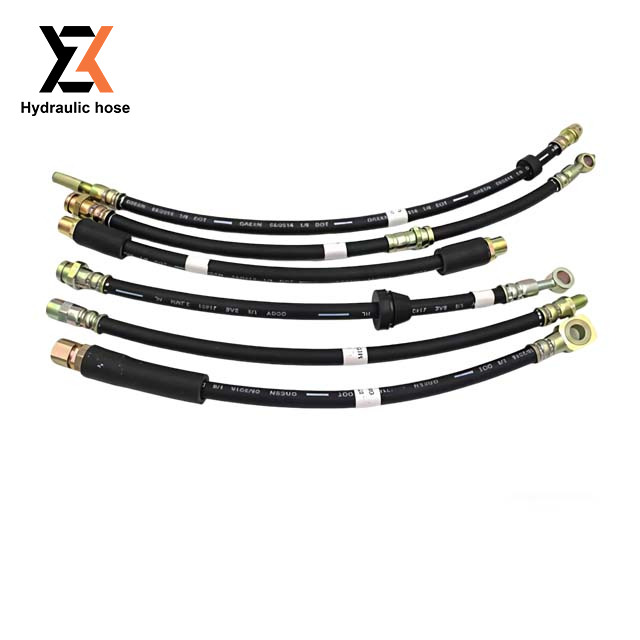
Material selection dictates the lifespan and reliability of the fitting. You must evaluate the operating environment, budget constraints, and performance requirements when specifying base metals and surface treatments. We see many failures in the field simply because the wrong material was chosen for the application environment.
Zinc-plated carbon steel remains the industry standard for OEM applications. It offers a highly cost-effective solution with adequate tensile strength for most passenger vehicles. The zinc plating provides a sacrificial barrier against oxidation. However, tool marks during installation easily compromise this plating. Once breached, the underlying carbon steel oxidizes rapidly. This compromises the structural integrity of the fitting over time.
Stainless steel alloys provide superior corrosion resistance and high tensile strength. These materials are ideal for performance, heavy-duty, or marine environments. The inherent chromium content forms a passive oxide layer that self-heals if scratched. The primary drawback is a higher procurement cost. You must mitigate the potential for galling if stainless steel fittings mate with identical stainless threads. We recommend proper anti-seize lubrication.
Brass is commonly utilized for specific adapters and inverted flares due to its excellent malleability. It conforms slightly under torque, creating a highly reliable mechanical seal. Aluminum is restricted to off-road or racing applications. It offers significant weight savings but possesses lower fatigue limits than steel. It is rarely DOT-approved for street use due to its susceptibility to stress fractures under continuous vibration.
Mating dissimilar metals introduces the risk of galvanic corrosion. When you thread a stainless steel fitting into an aluminum caliper, an electrolyte like salt water initiates an anodic/cathodic reaction. The aluminum corrodes at an accelerated rate. You mitigate this risk by specifying appropriate thread sealants, dielectric pastes, or utilizing intermediate adapters manufactured from compatible materials.
| Material Type | Tensile Strength | Corrosion Resistance | Primary Application | Field Failure Risk |
|---|---|---|---|---|
| Zinc-Plated Steel | High | Moderate (Sacrificial) | Standard OEM passenger vehicles | Plating damage leading to rust |
| 304 Stainless Steel | Very High | Excellent | Heavy-duty, marine, performance | Thread galling without lubrication |
| Brass | Moderate | Good | Adapters, specific flare seats | Deformation from over-torquing |
| 7075 Aluminum | Moderate | Good (Anodized) | Closed-course racing | Fatigue cracking under vibration |
The interface between the flexible assembly and the rigid system component dictates the sealing integrity. Selecting the correct thread pitch and seating geometry prevents fluid weepage. We frequently encounter leaks caused by mismatched flare angles.
Flare fittings rely on metal-to-metal contact to create a seal. SAE 45-degree inverted flares feature a concave seat on the fitting and a convex flare on the hard line. DIN/ISO bubble flares utilize a convex shape on the tube end that mates with a concave seat in the port. JIS standards introduce further geometric variations. Matching the flare angle and seat type is the most critical step. Forcing mismatched flares together distorts the metal and guarantees a failure under pressure.
Banjo fittings work perfectly for tight clearances where a 90-degree fluid exit is required immediately upon exiting the caliper. Specification requirements must detail the exact adapter sizing, such as 3/8-inch, M10, or AN-3 options. Sealing integrity relies entirely on crush washers positioned on both sides of the banjo block. Specifying copper versus aluminum crush washers depends on the mating surface materials. You must establish strict torque limits to ensure the washers compress sufficiently without stripping internal threads.
Implementation reality dictates that at least one end of the assembly should feature a swivel fitting. A swivel design prevents torsional twisting of the PTFE or rubber core during installation. Inducing a twist into the hose drastically reduces its burst strength and fatigue life. Evaluating swivel joint seals requires choosing between O-rings and mechanical seals. Mechanical seals generally offer better long-term reliability under high-pressure spikes.
| Interface Type | Sealing Mechanism | Torque Sensitivity | Common Usage |
|---|---|---|---|
| SAE 45° Inverted Flare | Metal-to-Metal Seat | High | Domestic master cylinders |
| DIN/ISO Bubble Flare | Metal-to-Metal Seat | High | European brake calipers |
| Banjo Fitting | Crush Washers (Copper/Alum) | Very High | Tight clearance caliper ports |
| AN-3 / JIC 37° | Metal-to-Metal Cone | Moderate | Performance aftermarket systems |
The method used to attach the fitting to the hose determines the structural integrity of the entire assembly. This connection withstands both hydrostatic pressure and mechanical tension. We rely on strict manufacturing controls to ensure these joints do not fail.
Factory crimping is the industry standard for achieving DOT compliance. This process requires calibrated dies to compress the metallic fitting collar over the exterior of the hose. The compression must grip the braided reinforcement layer without crushing the inner fluid-carrying tube. Quality assurance metrics are rigorous. Manufacturers rely on crimp diameter verification using digital micrometers. We also use volumetric expansion testing to ensure the inner tube remains unobstructed and structurally sound after compression.
Swaging is an alternative method where the fitting is forced through a tapered die. This reduces the outer diameter of the collar, compressing it onto the hose. Both crimping and swaging provide excellent pull-off strength. The choice between the two often depends on the specific hose construction and the manufacturer's tooling capabilities. Regardless of the method, the final joint must pass the FMVSS 106 tensile strength requirements.
Reusable fittings offer field serviceability but introduce significant engineering risks. The assembly architecture relies on a compression sleeve, often an olive or brass ferrule. This secures stainless steel braided PTFE hoses. As you tighten the fitting body, the ferrule compresses against the PTFE core. Reusable fittings rarely meet FMVSS 106 standards for public highway use. They carry significant liability if assembled incorrectly by end-users. Improper torque or ferrule placement leads directly to catastrophic blow-outs under pressure.
Accurate length calculations ensure the hose accommodates full suspension articulation without experiencing tension or excessive slack. Improper length specification is a leading cause of premature failure in the field.
Establishing standardized measurement points is the first step in specification. Overall length measures from the absolute end of one fitting to the absolute end of the other. Center-to-center measurement is often more accurate for banjo fittings. You measure from the center of one banjo eye to the center of the other. Clear documentation of these measurement points prevents manufacturing discrepancies.
Industry acceptable deviations vary based on the total length of the assembly. A standard brake hose length tolerance typically ranges from ±0.125 inches for short assemblies to ±0.500 inches for long runs. You must understand how the physical dimensions of the chosen end fitting impact the total flexible length. A long, rigid crimp collar reduces the active flexible area of the hose. This requires a longer overall assembly to achieve the same bend radius capabilities.
Routing paths must account for dynamic vehicle movements. The design accommodates full suspension droop, steering lock-to-lock articulation, and maximum jounce without stretching or kinking the hose. Specifying fittings with integrated strain reliefs or utilizing support brackets prevents localized stress at the crimp joint. Proper routing keeps the assembly away from moving suspension components and high-heat sources like exhaust manifolds.
What are the peak system pressure spikes, and do the selected fittings match or exceed the required hydrostatic burst ratings?
Does the elastomer or PTFE core, along with the fitting plating and any internal O-rings, withstand the selected brake fluid across all anticipated temperature extremes?
What is the exact routing path, and does the design account for dynamic length tolerance changes during maximum suspension travel and steering articulation?
Will the assembly be exposed to high-corrosion environments, such as marine applications or heavy road salt usage, necessitating the specification of stainless steel over standard zinc-plated carbon steel?
Does the specific application require strict 49 CFR 571.106 compliance, complete with certified manufacturer labeling bands and documented batch testing?
Even with correct component specification, installation errors compromise the entire system. Recognizing these risks allows you to develop robust installation procedures and torque guidelines. We see many perfect assemblies ruined by poor installation practices.
Improper torque specifications account for a significant percentage of fitting failures. Over-torquing causes flared seat distortion. This cracks the flare and creates an immediate leak. Under-torquing fails to seat the flare or compress the banjo crush washers adequately. This causes fluid weepage under high pressure. You must document precise torque values and adhere to them during assembly.
Torsional stress destroys hoses from the inside out. Installing a hose with a twist induces severe stress on the internal core and braided reinforcement. As the suspension cycles, this pre-loaded twist causes the core to fatigue and eventually rupture. Utilizing a hydraulic brake hose assembly with at least one swivel end eliminates this installation risk.
The infiltration of counterfeit or non-compliant components presents a massive liability. Sourcing unverified offshore fittings that claim DOT compliance but fail basic metallurgical and burst tests puts end-users in direct danger. You must demand material certifications and independent testing data to verify the structural integrity of all procured fittings.
Audit current supplier compliance certificates to verify adherence to FMVSS 106 standards.
Request documented salt-spray and burst test data for any new fitting designs before integration.
Consult with a fluid power engineer to verify thread pitch and flare compatibility across all mating components.
Establish strict, documented torque specifications for the assembly line to prevent installation-induced failures.
A: Acceptable tolerance depends on the overall length. Assemblies under 12 inches typically have a tolerance of ±0.125 inches. Longer assemblies allow up to ±0.500 inches. The tolerance must not allow the hose to become taut under full suspension droop or excessively slack.
A: Yes, any fitting intended for use on public highways must meet 49 CFR 571.106 (FMVSS 106) standards. Off-road racing vehicles are exempt from federal highway regulations, but utilizing DOT-compliant components remains a best practice for safety.
A: Crimping uses radial dies to compress the fitting collar inward onto the hose. Swaging forces the fitting through a tapered die to achieve compression. Both methods are acceptable for DOT compliance if they pass volumetric expansion and burst testing.
A: The FMVSS 106 standard requires fittings to show zero base metal corrosion after a 24-hour salt spray exposure. Manufacturers must use high-quality zinc plating on carbon steel or specify inherently corrosion-resistant materials like stainless steel or brass.
A: Yes, but you must mitigate galvanic corrosion risks. Using an appropriate anti-seize compound or thread sealant prevents the anodic reaction that causes the aluminum threads to corrode and seize against the stainless fitting.
A: A swivel fitting allows the hose to be installed and tightened without inducing a torsional twist into the core material. Twisting the hose severely degrades its burst strength and fatigue life, leading to premature failure.


