

Views: 0 Author: Site Editor Publish Time: 2026-07-23 Origin: Site


Unexpected sprayer downtime during critical, time-sensitive agricultural application windows carries severe operational and financial costs. When equipment fails in the field, operators face immediate delays, missed weather windows, and compromised crop protection schedules. These interruptions often stem directly from improper hose selection and inadequate system planning.
Mismatched hose specifications, such as incorrect pressure ratings or poor chemical compatibility, inevitably lead to internal degradation, pressure loss, environmental hazards, and clogged nozzles. A hose that cannot withstand the specific chemical mixtures or operating pressures of your equipment will fail prematurely. This causes leaks or internal flaking that disrupts the entire application process. Understanding the technical requirements of your spraying system prevents these costly failures.
This guide provides a technical, evidence-based framework for evaluating, specifying, and integrating the correct Spray Hose to ensure reliable performance across diverse agricultural applications. By analyzing material compatibility, pressure demands, and routing constraints, you can design a robust plumbing system that maximizes equipment uptime and application accuracy.
Match hose material composition strictly to the chemical profiles of the pesticides, herbicides, and fertilizers being applied to prevent internal tube degradation.
Calculate required volumetric flow rates and maximum system pressures before specifying a high pressure spray hose to ensure adequate safety margins.
Prioritize kink resistance and minimum bend radius specifications (aligning with international standards like FAO baselines) to maintain consistent flow during complex equipment routing and boom folding.
Implement proactive maintenance protocols, including post-installation calibration, routine pressure testing, proper nozzle cleaning, and winterization, to maximize hose lifespan.
Hose failures generate significant financial impacts well beyond the simple cost of replacement parts. Chemical spills result in wasted agricultural inputs, which are heavily budgeted and expensive to replace. Accidental discharges of concentrated herbicides or pesticides often lead to regulatory compliance violations, requiring mandatory reporting and expensive environmental remediation efforts. When a line bursts near a waterway or sensitive adjacent crop, the liability scales rapidly.
Secondary costs arise from yield reduction caused by delayed application windows. Agricultural treatments rely on precise timing. Missing a 48-hour window for fungicide application because a sprayer is down for mid-field repairs leaves crops vulnerable to aggressive diseases. Additionally, managing a failure event requires massive operational overhead. Field crews must stop planting or harvesting to assist with purging, draining, and cleaning a contaminated or degraded hose system before work can resume safely. This diverts labor from revenue-generating tasks.
A reliable spraying system demands a consistent volumetric flow rate from the pump to the nozzle body. Accurate chemical application relies entirely on maintaining steady pressure and flow across the entire boom width. Any fluctuation caused by internal hose restrictions, swelling, or kinking compromises the coverage and effectiveness of the treatment. If the outer nozzles receive less pressure than the center nozzles, the field receives an uneven chemical application, leading to weed escapes or inadequate pest control.
Equally important is the requirement for zero chemical permeation or internal tube flaking over the course of the operating season. The inner tube must remain structurally intact. When incompatible chemicals attack the hose liner, the material softens and sheds microscopic debris. This debris travels downstream, lodging in screens and obstructing the spray pattern at the nozzle orifice. A baseline requirement for any agricultural hose is absolute chemical stability with the intended tank mix.
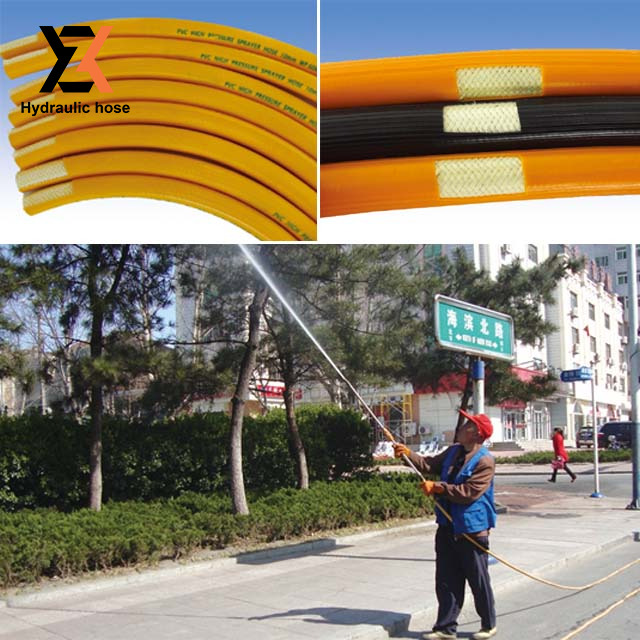
Selecting the correct pressure rating requires differentiating between maximum working pressure and burst pressure. Industry-standard safety margins dictate a 3:1 or 4:1 ratio between burst and working pressure to accommodate unexpected mechanical stress. If a system operates at 100 PSI, the hose must possess a burst rating of at least 300 to 400 PSI. Operating a hose at or near its burst pressure guarantees premature failure and severe safety risks for the operator.
Certain applications strictly require a high pressure spray hose. Orchard sprayers, long-distance delivery systems, and equipment designed for high-canopy penetration often operate between 400 and 800 PSI to achieve the necessary droplet atomization and canopy reach. In contrast, standard pressure broadcast lines typically operate below 100 PSI. System designers must also account for pressure spikes, commonly known as water hammer. These spikes occur during pump engagement, rapid valve shut-offs, and automated section control operations, sending shockwaves through the plumbing that can easily exceed the static operating pressure.
Evaluating common inner tube materials against harsh solvents, oil-based chemicals, and liquid fertilizers dictates the lifespan of the plumbing system. Emulsifiable concentrate (EC) formulations often contain aggressive solvents like xylene, which rapidly degrade standard PVC liners. Liquid fertilizers, such as UAN 32, require specific synthetic rubber or polymer liners to prevent long-term permeation and structural weakening.
Installing a dedicated chemical spraying hose prevents internal material breakdown, which remains the primary cause of clogged spray nozzles. The outer cover must also meet stringent UV, ozone, and weather resistance requirements. Agricultural environments expose equipment to intense, direct sunlight and fluctuating weather conditions. Without robust UV inhibitors in the outer jacket, the hose will suffer from premature cracking, dry rot, and eventual jacket separation.
Minimum bend radius specifications dictate how tightly a hose can be routed around sprayer frames without restricting internal flow. The FAO standard for agricultural sprayers establishes a clear, measurable baseline: the hose must not kink or flatten to obstruct flow when bent 180 degrees with an unsupported radius of 50 mm at 25°C. Hoses that fail this metric will choke the pump output when routed through complex boom fold joints.
Ambient temperature variations significantly impact hose flexibility and performance. Cold-weather stiffening makes routing difficult and increases mechanical stress on fittings during boom deployment. Conversely, hot-weather softening reduces the effective pressure rating of the material and increases susceptibility to kinking or external abrasion. Operators working in extreme climates must verify temperature derating charts provided by the manufacturer.
External abrasion factors vary wildly based on the layout of the application area. Friction from dragging hoses across concrete floors or gravel pathways in greenhouse bays presents entirely different challenges than trailing hoses through soft turf or row-crop fields. Greenhouse applications often require smooth, non-marking covers that resist concrete abrasion, while field applications demand heavy ribbed covers to withstand rocks and crop stubble.
Cover durability requirements escalate when hoses are exposed to mechanical friction from orchard tree branches, dense canopy dragging, or constant vibration against metal sprayer frames. Assessing the specific terrain ensures the selected hose cover can withstand the physical demands of the operating environment without exposing the internal reinforcement braiding to moisture and chemical attack.
PVC hoses are highly cost-effective and lightweight, making them suitable for general weed control, low-to-medium pressure broadcast spraying, and budget-conscious operations. They offer excellent visibility for identifying blockages if clear variants are used. However, they lack extreme temperature flexibility. PVC becomes rigid in cold weather and softens considerably under high heat, which lowers its pressure threshold. They also exhibit lower resistance to aggressive solvents found in certain pesticide formulations.
Rubber and EPDM blends offer superior durability, excellent weather resistance, and exceptional kink resistance. They excel in high-temperature applications, handling specific harsh agricultural chemicals, and enduring heavy-duty mechanical environments. EPDM is particularly resistant to agricultural fertilizers and ozone degradation. The trade-offs include heavier physical weight, which adds drag to manual spraying operations, and a higher upfront cost compared to standard PVC options.
Polyurethane hoses provide excellent chemical resistance and longevity. They are ideal for environments requiring high abrasion resistance and applications needing a lightweight, high-pressure solution. Polyurethane resists gouging and dragging wear better than rubber or PVC. While they typically represent the highest initial capital investment, their extended lifespan and reduced maintenance requirements often justify the cost in demanding, high-acreage agricultural settings.
| Hose Material | Best Use Cases | Key Advantages | Primary Limitations | Typical Pressure Range |
|---|---|---|---|---|
| PVC / Ribbed PVC | General weed control, broadcast spraying, turf care | Cost-effective, lightweight, easy to handle | Limited temperature flexibility, lower solvent resistance | 50 - 300 PSI |
| Rubber / EPDM | Harsh chemicals, high temperatures, liquid fertilizers | High durability, excellent kink resistance, ozone resistant | Heavier weight, higher upfront cost, higher drag friction | 150 - 600 PSI |
| Polyurethane | High abrasion environments, lightweight high pressure needs | Exceptional chemical resistance, long lifespan, gouge resistant | Highest initial capital investment, stiffer at extreme cold | 300 - 800+ PSI |
Matching the hose Inner Diameter (ID) to pump outlets, manifolds, and nozzle bodies prevents flow restriction and pressure drops. Proper sizing ensures the pump operates efficiently and delivers the required volume to the nozzles without cavitation. Undersized hoses force the pump to work harder, generating excess heat and reducing the lifespan of the pump seals.
Evaluating fitting types determines the security of the connection under dynamic loads. Crimped fittings offer a permanent, high-pressure seal ideal for main delivery lines, while clamped fittings allow for easier field repairs on low-pressure boom sections. Utilizing corrosion-resistant materials, such as stainless steel or specialized poly fittings, secures the chemical line and prevents rust degradation at the connection points, which is common when handling liquid fertilizers.
Securing hoses to sprayer booms prevents abrasion from machine vibration and uneven field terrain. Operators should use cushioned clamps or heavy-duty zip ties with saddle mounts to prevent the hose jacket from rubbing directly against sharp metal edges. Proper routing minimizes slack and avoids pinch points during boom folding or equipment articulation.
Designing the plumbing architecture for efficient, complete system draining avoids cross-contamination between different chemical applications. A well-planned layout eliminates low spots where chemicals can pool. This facilitates quick purging, simplifies triple-rinsing procedures, and ensures that residual herbicides do not accidentally damage sensitive crops during the next application pass.
After installing a new agricultural spray hose, calibration steps verify that hose length, routing, and diameter have not caused unexpected pressure drops. Operators must verify flow rates at individual nozzle bodies to ensure uniform output across the entire boom.
Fill the sprayer tank with clean water and bring the pump up to the standard operating pressure.
Open the boom valves and allow the system to purge all trapped air from the new lines.
Place a calibrated catch container under each nozzle across the boom.
Run the system for exactly one minute and record the fluid volume collected in each container.
Compare the collected volumes against the nozzle manufacturer's flow charts and check for variances greater than 5% between individual nozzles.
Adjust system pressure or inspect specific hose routing segments if significant pressure drops are detected on the outer boom sections.
Establishing visual inspection routines helps detect micro-abrasions, outer cover blistering, and weeping at fitting connections before they escalate into major failures. Operators should walk the boom before every major application shift, checking for areas where the hose may have rubbed against the frame or where UV exposure has caused the jacket to chalk and crack.
Monitoring and comparing pump pressure gauges against nozzle-tip pressures identifies internal hose swelling, kinking, or partial blockages that disrupt flow. If the main pump gauge reads 60 PSI but the boom-end gauge reads 40 PSI, there is a severe restriction in the delivery line. This diagnostic approach allows operators to replace failing segments before they burst under load.
Internal hose flaking and material degradation lead to recurring nozzle clogs, severely impacting application uniformity. When incompatible chemicals strip the inner liner, small rubber or plastic particles travel directly into the nozzle screens. If operators notice a sudden change in the spray pattern, such as streaking or heavy edges, a clog is likely present.
When clearing clogged nozzles, follow strict safety protocols. Safely remove the nozzle from the body while wearing appropriate PPE. Clean the orifice strictly with a soft-bristled nozzle cleaning brush and an approved neutralizing solvent. Never use metal wires, pocket knives, or compressed air from a dirty shop compressor. Metal tools ruin the precision orifice geometry, permanently altering the spray pattern and flow rate.
Proper flushing procedures, tank cleaning, and neutralizing agents remove chemical residues inside the system. Leaving harsh chemicals in the lines over the winter accelerates liner degradation and guarantees clogged nozzles in the spring. Operators must circulate a commercial tank cleaner through all lines, followed by a thorough clean water rinse.
Draining and compressed-air blowout protocols prevent freeze-thaw damage during winter storage. Water left in the lines will freeze, expand, and rupture the hose walls or crack expensive poly fittings. After blowing out the lines with low-pressure compressed air, circulating RV antifreeze through the pump and boom lines provides a final layer of protection against ice expansion and keeps internal seals lubricated.
Standardizing spray hose selection based on rigorous chemical compatibility and working pressure data ensures reliable, safe agricultural spraying. Decision-makers must audit their current pump capacities, chemical usage profiles, terrain-specific abrasion risks, and boom routing constraints before finalizing a purchase. Relying on guesswork or purchasing based solely on upfront costs leads to catastrophic field failures.
Audit your chemical inventory and cross-reference all active ingredients with the hose manufacturer's chemical resistance charts.
Calculate your maximum system pressure, including potential water hammer spikes, and select a hose with a minimum 3:1 burst safety factor.
Measure the required bend radius for your specific boom fold joints to ensure the selected hose will not kink during transport.
Establish a mandatory pre-season and post-season inspection checklist to identify jacket wear and fitting degradation early.
A: Working pressure is the maximum continuous pressure the hose handles safely during normal operation. Burst pressure is the absolute maximum pressure the hose withstands before catastrophic failure. Industry standards require burst pressure to be 3 to 4 times higher than working pressure to provide a necessary safety margin against pressure spikes.
A: Calculate the correct inner diameter based on the required volumetric flow rate and the maximum acceptable pressure drop over the hose length. Match the ID to your pump output and manifold requirements to ensure unrestricted flow to the nozzles without causing pump cavitation.
A: Kinking at fold joints occurs when the hose's minimum bend radius is exceeded, or if the material lacks sufficient flexibility for the ambient temperature. Upgrading to a hose with a tighter bend radius or adjusting the routing layout with cushioned clamps resolves this issue.
A: The FAO standard requires that when a hose is bent 180 degrees with an unsupported radius of 50 mm at a temperature of 25°C, it must not kink or flatten enough to obstruct the internal flow. Hoses failing this test restrict chemical application.
A: Replacement intervals depend on usage intensity, chemical exposure, and environmental factors. Replace hoses immediately if visual inspections reveal cover blistering, deep abrasions, weeping fittings, or if recurring nozzle clogs indicate internal liner degradation.
A: Remove the nozzle from the body and clean it using only a soft-bristled nozzle cleaning brush and appropriate cleaning solution. Never use metal wires, pins, or knives, as these permanently damage the precision orifice geometry and ruin the spray pattern.
A: High ambient temperatures soften hose materials, significantly reducing their effective maximum working pressure. Conversely, cold temperatures stiffen the hose, reducing flexibility and increasing the risk of jacket cracking or fitting stress during boom routing and deployment.


