

Views: 0 Author: Site Editor Publish Time: 2026-06-23 Origin: Site


Engineers and buyers frequently encounter overlapping specifications when sourcing medium-pressure hydraulic lines. Navigating these minor technical variances often creates unnecessary procurement hurdles for maintenance teams. Global supply chains constantly force maintenance professionals to decide if an American standard can replace a European component. Selecting the wrong standard can quickly escalate into a serious operational problem. Misunderstanding the assembly requirements of these specific "A" and "ST" designations can lead to unexpected fitting blowouts on the factory floor.
You also risk catastrophic machine downtime or compliance failures when exporting equipment to highly regulated markets. Replacing a ruptured line requires more than just matching the inner diameter; you must understand the entire structural profile. This guide breaks down the critical technical tolerances, skiving requirements, and true interchangeability of SAE 100R1A and DIN EN853 1ST hoses. We will help you support risk-free specification and confident purchasing decisions for all your mobile and industrial machinery.
Functional Equivalence: Both are single steel wire braided hoses designed for medium-pressure hydraulic oil applications, often overlapping entirely in modern manufacturing capabilities.
Assembly Distinctions: The "A" in SAE 100R1A and the "ST" in DIN EN853 1ST indicate standard cover thicknesses, meaning both typically require skiving (removing the outer rubber cover) before crimping fittings.
Fitting Compatibility is Critical: While the hoses themselves are often interchangeable or dual-certified, the specific crimp fittings and ferrules must strictly match the regional standard of the equipment to prevent catastrophic failure.
Modern Sourcing Reality: Most reputable manufacturers now produce dual-certified hoses that meet both SAE and DIN EN parameters simultaneously, streamlining inventory management.
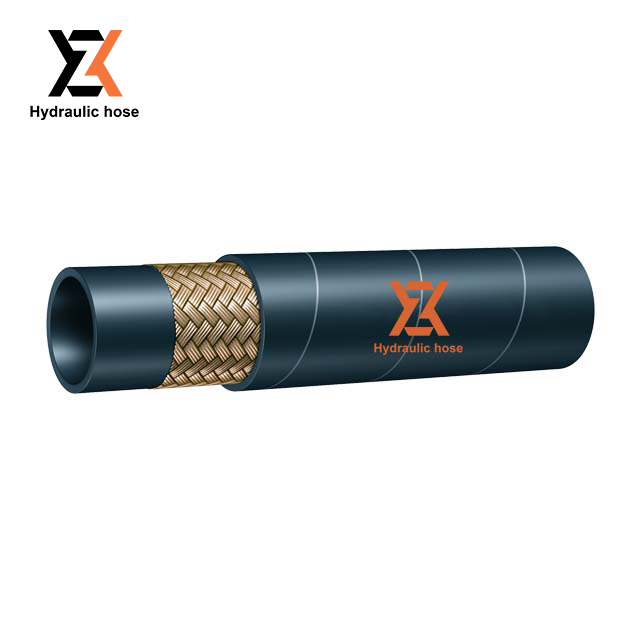
The Society of Automotive Engineers (SAE) created the J517 standard to govern flexible fluid power lines. Within this widespread framework, a SAE 100R1A hydraulic hose meets highly specific structural requirements. It features an oil-resistant synthetic rubber inner tube, typically formulated from a robust Nitrile compound. A single layer of high-tensile steel wire braid provides necessary internal reinforcement against sudden fluid surges. Finally, a weather-resistant outer rubber cover protects the core assembly from ozone degradation and physical abrasion.
You will typically see this specification dominating US-manufactured mobile equipment. It remains incredibly popular in agricultural machinery, forestry attachments, and standard industrial hydraulics. Buyers consistently rely on SAE standards because they offer predictable, standardized performance across North American supply chains.
The European Norm (EN) and the Deutsches Institut für Normung (DIN) established a parallel regulatory framework for fluid power systems. A DIN EN853 1ST hose represents the definitive European equivalent for medium-pressure routing applications. The "1" explicitly designates a single wire braid structure. The "ST" refers to the standard cover thickness of the outer rubber layer.
This specification strictly adheres to tight metric dimensional tolerances from the inner core to the outer jacket. It dominates European-engineered OEM equipment, ranging from heavy excavators to precision injection molding machines. Manufacturers rely heavily on this standard to maintain consistent performance metrics across the entire EU market. Understanding this metric-first approach helps you properly source replacement parts for imported machinery without risking compatibility issues.
You must evaluate standard dimensional and pressure charts to understand true operational capabilities. When comparing maximum working pressures across common internal diameters (ranging from 1/4" to 2"), subtle differences emerge between the two systems. Historically, the DIN EN853 1ST standard demands slightly higher working pressure ratings at certain larger diameters. Legacy SAE standards allowed slightly lower pressure thresholds for the exact same bore size.
Today, modern manufacturing processes largely bridge this historical gap. Advanced extrusion and braiding techniques allow most manufacturers to produce a single product perfectly capable of meeting the higher European pressure thresholds across the board. The chart below illustrates the historical pressure expectations for smaller bore sizes.
| Hose Size (Dash Size) | Internal Diameter (Inch) | SAE 100R1A Max Pressure (PSI) | DIN EN853 1ST Max Pressure (PSI) |
|---|---|---|---|
| -4 | 1/4" | 3,270 | 3,270 |
| -6 | 3/8" | 2,250 | 2,610 |
| -8 | 1/2" | 2,000 | 2,320 |
| -12 | 3/4" | 1,250 | 1,530 |
| -16 | 1" | 1,000 | 1,270 |
Inner diameter (ID) boundaries remain consistent across both standards, but outer diameter (OD) limits show minor variations. The DIN standard generally mandates tighter metric tolerances concerning the outer rubber cover thickness. These millimeter-level differences matter significantly when you are selecting ferrules for final assembly.
You must determine the exact crimp diameters based on the actual hose OD. Using an oversized ferrule on a marginally undersized hose severely compromises the structural integrity of the final crimp. Conversely, forcing a tight ferrule over a thicker SAE cover can damage the reinforcement wire before the crimping machine even activates.
Both standards share an identical operational temperature range, ensuring versatile field application. They typically perform flawlessly from -40°C to +100°C (-40°F to +212°F). Cold weather starts test the flexibility of the rubber, while high heat pushes the limits of the compound's stability.
You can safely use either specification as a highly reliable hydraulic oil hose. They seamlessly handle petroleum-based fluids and standard water-glycol mixtures without degrading the synthetic rubber core. However, continuous operation at the absolute maximum temperature limit will eventually harden any rubber compound. You should continuously monitor lines operating near 100°C for premature brittleness or micro-cracking.
The suffixes "A" and "ST" explicitly define the mandatory assembly process for the technician. Unlike "AT" or "SN" designations (which signify thin-cover, no-skive options), these specific variants carry a significantly thicker rubber cover. You must generally peel back this outer rubber to fully expose the steel wire braided hose layer. This vital material removal process is called external skiving. It ensures the metal ferrule bites directly into the metal reinforcement layer.
Failure to properly skive these specific hoses introduces a severe operational risk factor. If you crimp directly over the thick rubber cover, the fitting loses its mechanical metal-to-metal grip. The thick rubber will eventually compress, shift, and extrude under dynamic load. This exact mistake invariably leads to slow fluid leaks or highly dangerous, high-velocity blowouts during system pressure spikes.
Best Practice: Always use a properly calibrated mechanical skiving tool to remove the exact length of rubber specified by your fitting manufacturer.
Common Mistake: Using a utility knife to manually carve off the rubber often cuts into the underlying wire braid. This ruins the structural integrity of the assembly immediately.
Mixing regional engineering standards presents a massive danger in pressurized fluid systems. You must pair a DIN EN hose with compatible metric or BSP (British Standard Pipe) fittings to maintain correct seating. Conversely, SAE hoses typically utilize JIC 37-degree flare, NPT, or ORFS fittings. The thread pitches, sealing faces, and cone angles differ drastically between these two distinct engineering philosophies.
Evaluators should follow one strict rule of thumb on the factory floor. Never mix and match hose standards and fitting standards without verified engineering data. Always check the manufacturer's validated crimp specifications before finalizing an assembly. Combining a metric ferrule design with an SAE hose body often results in an under-crimped or over-crimped connection, bypassing the safety margins entirely.
You can safely substitute one standard for the other under specific, verified conditions. Modern procurement often relies on this flexibility to keep machinery running during supply chain shortages. Follow these steps to validate a safe swap:
Check if the manufacturer provides a dual-certification stamp reading "SAE 100R1A / EN853 1ST" printed directly on the layline.
Verify the procurement team has sourced dual-compatible ferrules designed expressly for these overlapping tolerances.
Confirm existing crimp specifications explicitly accommodate the exact OD and wire diameter of the substitute product.
Test the first assembled prototype using a caliper to ensure the final crimp diameter perfectly matches the manufacturer's tolerance chart.
Certain operational scenarios demand strict adherence to original equipment specifications. OEM warranty compliance often dictates exact replacement rules. If a machine's warranty requires strict adherence to European (DIN) or American (SAE) replacements, you must comply to avoid voiding financial coverage.
Furthermore, consider regional regulatory export requirements. Equipment destined for the European Union often requires strict CE marking. This rigorous safety certification process heavily favors EN-certified components over their SAE equivalents. Substituting an SAE line on a machine bound for Germany might cause the unit to fail customs inspections or local safety audits.
Standardizing on dual-certified single wire braided hoses greatly benefits maintenance departments. This strategic approach aggressively reduces SKU bloat inside your warehouse. Purchasing complexity drops significantly when one single hose specification satisfies both American and European equipment demands.
You immediately free up valuable shelf space. More importantly, you drastically reduce the chance of a technician pulling the wrong hose during a high-stress, late-night repair shift. Simplified inventory translates directly into faster repair times and fewer assembly errors.
Do not simply accept static pressure ratings from a generic supplier catalog. You must demand concrete evidence of dynamic impulse testing. A standard 1-wire hose should comfortably pass 150,000 impulse cycles under strict laboratory conditions. During this test, pressure rapidly spikes to 133% of the maximum working pressure while the fluid remains heated.
This critical data verifies long-term fatigue resistance under real-world pressure fluctuations. A hose surviving rigorous dynamic testing will endure the harsh hydraulic shocks typical in heavy agricultural machinery and industrial presses.
Evaluate the actual raw materials used during the extrusion process. Ask potential suppliers about the specific quality of the synthetic rubber, specifically the NBR (Nitrile Butadiene Rubber) compound used for the inner tube. A high-quality inner tube resists chemical breakdown from modern synthetic fluids.
Furthermore, rigorously verify the tensile strength of the reinforcement steel wire. High-tensile wire prevents the hose body from expanding, ballooning, and failing under sudden shock loads. Inferior wire often stretches over time, leading to premature fatigue failures near the crimped fitting.
Ensure the supplier implements continuous, highly legible branding along the entire layline. You need clear manufacturing dates, factory codes, and distinct lot numbers visible at a glance. Every SAE 100R1A hose or DIN equivalent must display explicit standard callouts.
This traceability directly protects your operation if a batch defect occurs months later. You can quickly identify, trace, and isolate compromised stock before it ends up installed on your critical machinery. Excellent traceability signals a manufacturer committed to rigorous quality control.
SAE 100R1A and DIN EN853 1ST hoses remain structurally comparable, serving the identical purpose of routing medium-pressure fluid safely. While their regional origins created slight dimensional differences historically, modern manufacturing allows them to frequently overlap. Understanding their shared skiving requirements prevents the most common cause of assembly failure.
To optimize your procurement and maintenance strategy, follow these action-oriented next steps:
Audit your current hose inventory to identify overlapping SAE and DIN specifications taking up redundant shelf space.
Consult your primary fitting supplier to confirm exact crimp compatibility for dual-certified hoses before transitioning your stock.
Standardize your assembly training procedures to ensure all technicians correctly identify external skiving requirements for "A" and "ST" designations.
Update your vendor evaluation guidelines to demand dynamic impulse testing data rather than relying solely on static catalog ratings.
Prioritize dual-certified hoses to maximize your inventory versatility. Maintain strict discipline regarding skiving procedures and fitting compatibility to ensure maximum operational safety across all your machinery.
A: The primary difference lies in the outer rubber cover thickness and the required assembly method. A 1ST hose features a thick standard cover and requires skiving, meaning you must physically peel back the outer rubber before crimping. A 1SN hose features a thinner outer cover specifically engineered for no-skive assembly, allowing you to crimp the fitting directly over the rubber.
A: Generally, no. The 100R1A standard specifies a thicker outer cover that directly interferes with the inner teeth of no-skive ferrules. Cimping over this thick rubber prevents metal-to-metal contact, risking blowouts. If you want to use convenient no-skive fittings, you must specify an "AT" designated hose (like SAE 100R1AT) designed specifically for that crimping style.
A: No, they are absolutely not interchangeable. The thread pitches, internal sealing angles, and ferrule designs differ significantly between the American and European standards. Mixing SAE fittings with DIN fittings prevents proper sealing and creates severe safety hazards, including slow fluid leaks and catastrophic blowouts under working pressure.


