


| Quantity: | |
|---|---|


In industries such as chemical processing, fertilizer production, mining, and wastewater treatment, conveyor belts are frequently exposed to corrosive materials that can quickly degrade standard rubber compounds. Our acid & alkali resistant conveyor belt is specifically engineered to perform reliably in these chemically aggressive environments, ensuring long-term stability and consistent material handling. Built on a high-strength fabric carcass, it utilizes specially formulated rubber compounds with enhanced resistance to acids, alkalis, and other corrosive substances, effectively minimizing swelling, degradation, and loss of mechanical strength. This allows the belt to maintain durability and flexibility while conveying materials such as fertilizers, chemicals, treated ores, and industrial waste. With stable performance across a typical operating temperature range of -20℃ to +80℃, it is suitable for both indoor and outdoor applications. At the same time, it retains good resistance to abrasion and mechanical stress, supporting continuous operation under demanding conditions. Compared to standard conveyor belts, this solution offers a more reliable balance of chemical resistance, durability, and service life—helping reduce maintenance frequency, lower replacement costs, and ensure safe, efficient conveying in corrosive environments.
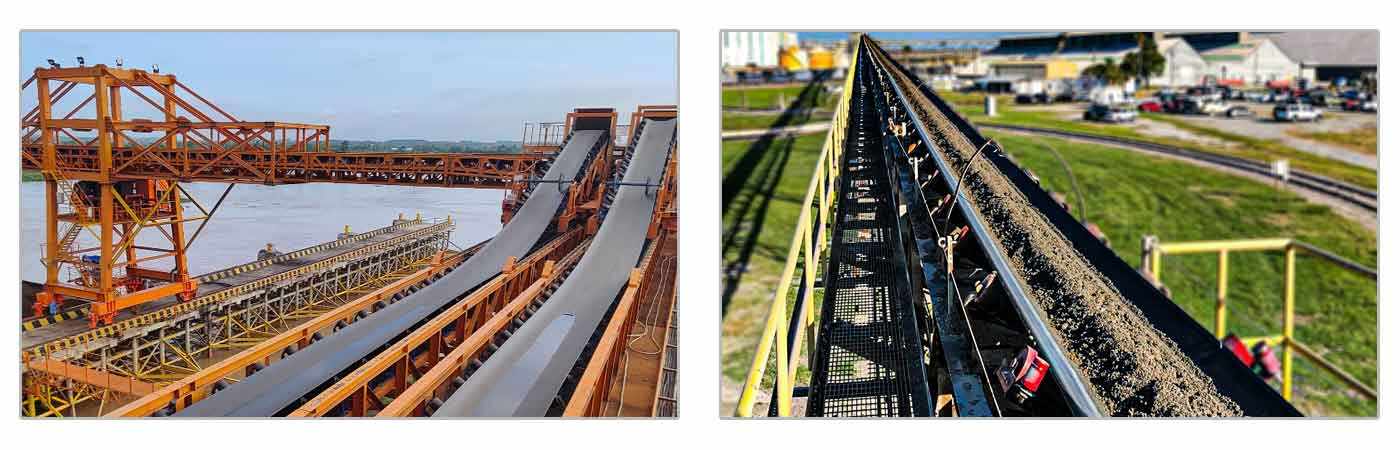
Acid & Alkali Resistant Cover Rubber:
Synthetic rubber blend (e.g., chloroprene rubber, EPDM) with low chemical reactivity—volume change ≤10% after 72h immersion in 20% H₂SO₄ or 20% NaOH (25℃).
Carcass:
Multi-ply fabric (EP/NN/CC) with anti-corrosion coating (polyester film), preventing acid/alkali from penetrating and damaging the fiber structure.
Core Rubber:
Acid-alkali resistant core rubber with strong adhesion, ensuring layer bonding strength ≥6.5N/mm even after chemical contact.
Sealed Structure:
Full-edge sealing and cover rubber thickening (top ≥4mm) block acid/alkali from entering the belt interior.
Resists 5%-30% sulfuric acid, hydrochloric acid, and 5%-25% sodium hydroxide, potassium hydroxide; volume change ≤10% and weight change ≤8% after 72h immersion.
EP/NN carcass has tensile strength up to 400N/mm, no strength loss after 30 days of acid/alkali exposure; cover rubber wear rate ≤0.12mm/month.
Works normally at -10℃~80℃, no performance degradation in high-temperature acidic environments (e.g., chemical reactor discharge).
Cover rubber is non-toxic and non-polluting, no heavy metal additives—meeting environmental standards for chemical industry use.
In 20% H₂SO₄ transport scenarios, service life is 2-3x longer than ordinary belts; low replacement frequency reduces downtime.
Special Options: Combined acid-alkali-heat resistance (≤125℃), acid-alkali-oil resistance.
Support small-batch orders with no MOQ:
backed by 20M meters annual capacity, we deliver small batches (e.g., chemical plant trial, acidic ore processing matching) on time.
Offer full customization:
Customize corrosion resistance level (for low/high concentration acid/alkali) and belt structure according to your material’s chemical properties.
Deliver high cost-effectiveness:
National-level laboratory tests verify corrosion resistance; optimized formula reduces costs without compromising performance.
Reference Specification:
| Carcass Type | Tensile Strength (N/mm) | Belt Width (mm) | Cover Thickness (mm) | Volume Change (%) | Weight Change (%) | Adhesion Strength (N/mm) |
|---|---|---|---|---|---|---|
| Top | Bottom | (20% H₂SO₄, 72h) | (20% NaOH, 72h) | |||
| CC56/70 | 56/70 | 400-2200 | 3-6 | 2-4 | ≤10 | ≤9 |
| EP/NN 100-200 | 100-200 | 400-2200 | 4-8 | 3-6 | ≤9 | ≤8 |
| EP/NN 250-400 | 250-400 | 400-2200 | 5-12 | 4-8 | ≤8 | ≤7 |
| Acid-Alkali-Heat Type | 100-400 | 400-2200 | 5-12 | 4-8 | ≤8 | ≤7 |


