


| Quantity: | |
|---|---|


In industries such as recycling, food processing, grain handling, and waste management where materials often contain oils and fats, conveyor belts are constantly exposed to conditions that can cause swelling, degradation, and premature failure. Our oil resistant conveyor belt is specifically engineered to handle these challenges, delivering reliable performance while maintaining structural integrity over time. Built on a high-strength fabric carcass, it utilizes specially formulated oil-resistant rubber compounds that effectively minimize volume change and prevent deterioration when in contact with mineral oils, vegetable oils, and greasy materials. At the same time, the belt retains excellent resistance to abrasion, wear, and mechanical stress, ensuring durability in continuous operation. With stable performance across a typical temperature range of -20℃ to +80℃, it is well-suited for conveying materials such as oily grains, processed foods, fertilizers, and industrial waste. Compared to standard conveyor belts, this solution offers a more balanced combination of chemical resistance, flexibility, and service life—helping reduce maintenance frequency, lower replacement costs, and maintain consistent conveying efficiency in oil-prone environments.
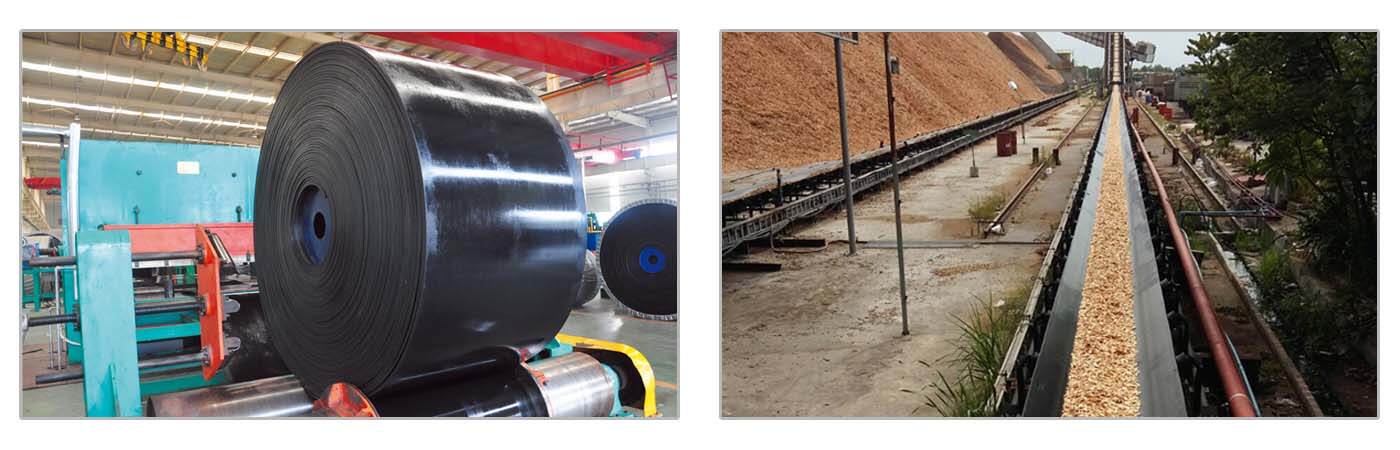
The oil resistant conveyor belt features an "oil-proof cover rubber + anti-oil infiltration carcass + oil-resistant core rubber" structure, solving oil-induced rubber swelling:
Sealed edge rubber blocks oil from entering the belt edge, avoiding edge hardening or cracking.
Cover rubber swells ≤15% and hardness change ≤10 Shore A after 72h immersion in 40℃ engine oil; no rubber peeling or carcass corrosion in long-term oil contact.
EP/NN carcass has low elongation (≤1.5%) and high modulus, bearing heavy oil-containing materials (e.g., asphalt, 2.5t/m³); impact resistance ≥50kJ/m².
Adapts to small-diameter conveyor rollers (minimum 150mm), suitable for mobile conveying equipment in oil refineries; stable trough formation ensures uniform material transport.
Works normally at -20℃~80℃, no hardening in low temperature or softening in high temperature—suitable for both indoor workshops and outdoor ports.
Support small-batch orders with no MOQ:
backed by 20M meters annual capacity, we deliver small batches (e.g., refinery trial, equipment matching) on time.
Offer full customization:
Customize cover rubber oil resistance level (for light/heavy oil), belt width, and carcass material according to your oil-containing materials.
Deliver high cost-effectiveness:
50+ years of rubber product experience, ISO/CE certification, and optimized oil-resistant formula ensure long life at an economical price.
Reference Specification:
| Carcass Type | Oil Resistance Level | Applicable Oil Type | Tensile Strength (N/mm) | Belt Width (mm) | Cover Thickness (mm) | Oil Swelling Rate (%) | Operating Temperature (℃) |
|---|---|---|---|---|---|---|---|
| Top | Bottom | (40℃ engine oil, 72h) | |||||
| CC56/70 | Standard | Light oil (gasoline, diesel) | 56/70 | 400-2200 | 2-6 | 2-4 | ≤15 |
| EP/NN 100-200 | Standard | Light oil (gasoline, diesel) | 100-200 | 400-2200 | 3-8 | 2-6 | ≤15 |
| EP/NN 250-400 | High | Heavy oil (asphalt, petroleum coke) | 250-400 | 400-2200 | 4-12 | 3-8 | ≤12 |
| EP/NN 100-400 | Oil-Heat Resistant | Heavy oil (asphalt, hot oil) | 100-400 | 400-2200 | 4-12 | 3-8 | ≤12 |
This table is for reference only. Please consult our sales staff for details.


