


| Quantity: | |
|---|---|


In cold storage facilities, winter mining operations, and outdoor material handling in low-temperature regions, conveyor belts must remain flexible and reliable despite extreme cold conditions that can cause standard belts to harden, crack, or fail. Our cold resistant conveyor belt is specifically engineered to perform consistently in sub-zero environments, ensuring stable and efficient material transport even in harsh climates. Built on a high-strength fabric carcass, it utilizes specially formulated cold-resistant rubber compounds that maintain elasticity and impact resistance at low temperatures, effectively preventing brittleness and surface cracking. This allows the belt to operate smoothly while handling materials such as coal, aggregates, and bulk goods in freezing conditions. With dependable performance in temperatures as low as -40℃ (depending on grade), it is well-suited for both indoor refrigerated systems and outdoor winter applications. At the same time, it retains strong resistance to abrasion and mechanical stress, ensuring durability under continuous use. Compared to standard conveyor belts, this solution offers a more reliable balance of flexibility, toughness, and service life in cold environments—helping reduce downtime and maintenance costs while maintaining consistent conveying performance.
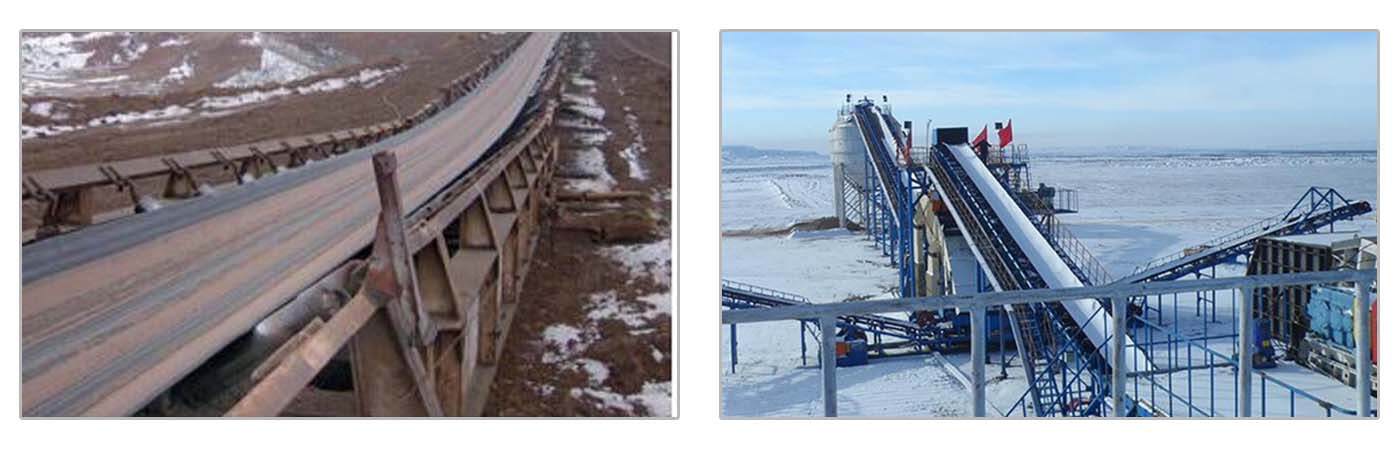
The cold resistant conveyor belt adopts a "low-temperature flexible cover rubber + anti-freezing carcass + cold-stable core rubber" structure, avoiding low-temperature brittleness:
Cold Resistant Cover Rubber:
Blend of natural rubber and butadiene rubber (NR/BR), with fragility temperature ≤-45℃—maintaining flexibility (Shore A hardness 55-65) without cracking at low temperatures.
Carcass:
Multi-ply fabric (cotton canvas, nylon canvas, EP canvas) with anti-freezing treatment, no fiber hardening or tensile strength loss at -45℃.
Core Rubber:
Cold-resistant core rubber with low glass transition temperature (Tg ≤-50℃), ensuring layer adhesion strength ≥6.0N/mm at -45℃.
Edge Protection:
Flexible edge rubber resists low-temperature cracking, adapting to outdoor wind and snow environments.
Works normally at -45℃, no brittleness or cracking even after 72h cold storage at -50℃; bending test (180° at -45℃) shows no layer separation.
EP/NN carcass has tensile strength up to 400N/mm, low elongation (≤1.8%) at -45℃; impact resistance ≥40kJ/m², resisting frozen ore impact.
Cover rubber resists UV radiation and ozone (ozone density 50pphm, 40℃/72h no cracks), suitable for long-term outdoor use in cold regions.
Suitable for both heavy industrial transport (frozen coal/ore) and light transport (frozen food); food-grade cover rubber option (compliant with FDA) for cold storage.
Flexible belt body is easy to splice (cold vulcanization available); low-temperature wear rate ≤0.15mm/month, reducing maintenance costs.
Special Options: Food-grade cold resistant (FDA compliant), cold-flame resistant (MT668 for cold-region mines)
Support small-batch orders with no MOQ:
backed by 20M meters annual capacity, we deliver small batches (e.g., cold-region mine trial, cold storage matching) on time.
Offer full customization:
Customize cold resistance level (for -30℃/-45℃), cover rubber type (industrial/food-grade), and belt width according to your low-temperature environment.
Deliver high cost-effectiveness:
50+ years of rubber formulation experience, ISO/CE certification, and optimized cold-resistant materials ensure low-temperature performance at an economical price.
Reference Specification:
| Carcass Type | Tensile Strength (N/mm) | Belt Width (mm) | Cover Thickness (mm) | Fragility Temperature | Operating Temp Range | Adhesion Strength (N/mm) |
|---|---|---|---|---|---|---|
| Top (上) | Bottom (下) | |||||
| CC56/70 | 56/70 | 400-2200 | 2-6 | 2-4 | ≤-40℃ | -45℃~50℃ |
| NN 100-200 | 100-200 | 400-2200 | 3-8 | 2-6 | ≤-45℃ | -45℃~50℃ |
| EP 100-400 | 100-400 | 400-2200 | 3-10 | 3-8 | ≤-45℃ | -45℃~50℃ |


