


| Quantity: | |
|---|---|


In high-temperature industries such as cement plants, steel mills, foundries, and power generation facilities, conveyor belts must withstand continuous exposure to heat without compromising performance or lifespan. Our heat resistant conveyor belt is engineered to handle these extreme conditions, delivering stable and reliable material transport even under elevated temperatures. Built on a high-strength fabric carcass, it incorporates specially formulated heat-resistant rubber compounds that significantly reduce thermal aging, cracking, and hardening caused by prolonged heat exposure. This allows the belt to maintain flexibility, strength, and structural integrity while conveying hot materials such as clinker, sinter, coke, and slag. Depending on the compound grade, it can handle continuous operating temperatures ranging from approximately 100℃ up to 200℃ or higher for short durations. At the same time, it retains strong resistance to abrasion and mechanical stress, ensuring durability in heavy-duty applications. Compared to standard conveyor belts, this solution offers a more effective balance between heat resistance, service life, and operational efficiency—helping reduce maintenance costs and downtime in high-temperature conveying environments.
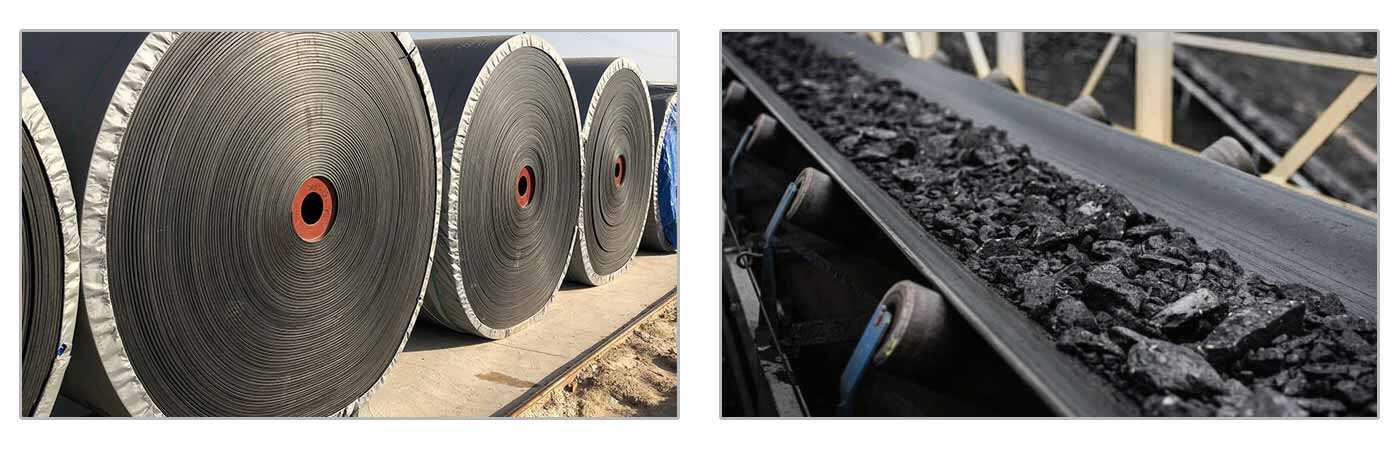
The heat resistant conveyor belt adopts a "high-temperature resistant cover rubber + heat-treated carcass + heat-stable core rubber" structure, resisting thermal aging:
Heat Resistant Cover Rubber: Classified by temperature resistance (HR120/HR150/HR180/HR200/HOR), with special heat stabilizers—no cracking, hardening, or softening under high temperatures.
Carcass: Multi-ply fabric (EP/NN/CC) (special heat treatment),reducing thermal shrinkage rate ≤1% (after 24h at rated temperature) and maintaining tensile strength.
Core Rubber: Heat-resistant core rubber with low thermal conductivity, isolating high temperatures from the carcass; adhesion strength ≥7.0N/mm at 160℃.
Back Cover Rubber: Wear-resistant back cover (Shore abrasion ≤150mm³) resists high-temperature roller friction.
HOR: For oil-containing high-temp materials (asphalt, ≤180℃)
Carcass thermal shrinkage ≤1% at rated temperature, no belt length change or deviation during long-term use.
Cover rubber wear rate ≤0.2mm/month (HR150 type); impact resistance ≥45kJ/m², resisting falling high-temp ore impact.
Heat aging test (70℃×168h for D/H type, 125℃×168h for T2 type) shows tensile strength retention ≥80%, service life up to 36 months.
Belt Selection
Support small-batch orders with no MOQ:
backed by 20M meters annual capacity, we deliver small batches (e.g., cement plant trial, asphalt equipment matching) on time.
Offer full customization:
Customize temperature resistance level, cover thickness, and carcass material according to your material’s exact temperature.
Deliver high cost-effectiveness:
National-level laboratory tests ensure heat resistance; optimized processes reduce costs while maintaining performance.
Reference Specification:
| Type | Tensile Strength ( ≥Mpa ) | Elongation at Break (≥ % ) | Abrasion ( ≤mm³) | Application |
| HR120 | 15 | 400 | 200 | Coke, sinter and low-temperature heat resistant |
| HR150 | 17 | 450 | 150 | Steel, casting and sinter |
| HR180 | 14 | 450 | 200 | Cement clinker, residues and dry powder |
| HR200 | 14 | 450 | 200 | Materials temperature exceed 200℃ |
| HOR | 15 | 400 | 200 | Asphalt and other oily materials |


